

Emergency departments sometimes need psychiatric assessments when no psychiatrist is available on site. Many other facilities, including small to medium-sized hospitals and prisons, will also want or require access to a psychiatrist, if not located in or close to a large city.
Many situations can therefore benefit from input via video-link from various specialties, including psychiatry. However, suitable numbers of practitioners, appropriate scheduling and suitable protocols will all be necessary.
All of these are aspects that FasPsych will provide and assist with on behalf of client organizations. It goes well beyond simply making a telemedicine platform available.
FasPsych
Editorial rating: 4.4 / 5
Verdict: FasPsych is a practical option for hospitals and correctional health teams that need to supplement existing psychiatric staffing.
| Assessment area | Score | Evidence behind the score |
|---|---|---|
| Clinical staffing coverage | 4.6 | Psychiatric provider network and multiple institutional settings |
| Implementation process | 4.4 | Documented matching, credentialing and launch assistance |
| Operational support | 4.4 | Technology coordination and support for existing workflows |
| Payment flexibility | 4.6 | Hourly, block, consultation and on-call billing options |
| Breadth of organizational fit | 4.0 | Strongest focus on psychiatric and behavioral-health needs |
Scores reflect the assessment of the documentation, public feedback, pricing and delivery evidence. The headline reflects the dimension average subject to any applicable rating ceiling or material trade-off cap.
Contents Of This Article
- Types Of Organizations Supplied With Psychiatric Staff
- Range Of Staff Available; Process Of Providing Cover
- Related Technical Support Provided
- Uses By Hospital And Prison Medical Staff
- Costs
- What Public Feedback Shows
- Pros And Cons
- Conclusion
Types Of Organizations Supplied With Psychiatric Staff
FasPsych supplies psychiatric staff to healthcare organizations to see their own patients, so this is not aimed at members of the general public seeking treatment. Hospitals, including emergency departments and psychiatric units, prisons and community mental health services would be examples, as would various others such as FQHCs, Indian and other tribal services, and general practices.
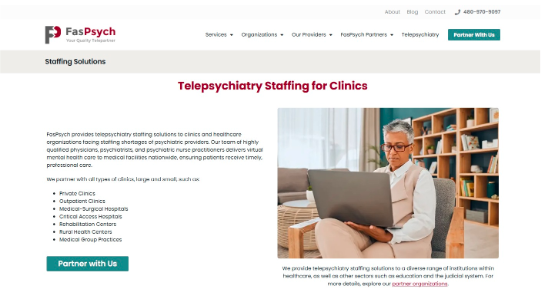
It has been in existence since 2007, providing assessments, medications, consultations, medical direction and other services. It is listed in one directory of telemedicine services published by the University of Arizona as supplying staff to institutions, and the Chief Administrative Officer is given as Abraham Barton, LCSW.
This model suits facilities that already manage patients through their own clinical teams. The various aspects of this would continue under local responsibility, supplemented by input from a psychiatrist and others via FasPsych.
Range Of Staff Available; Process Of Providing Cover
Many psychiatrists and psychiatric nurse practitioners, plus others, apparently throughout the country, provide cover for outpatients, inpatients and other types of consultations.
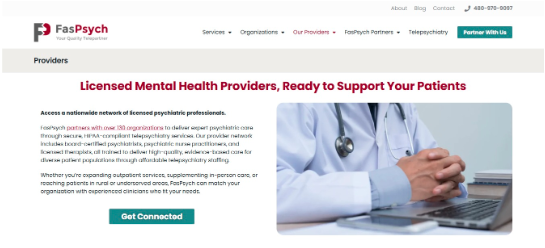
Obvious limitations apply to re-licensing of individual clinicians in various states. So availability to meet any requirement would vary around the country.
Various steps are outlined on the website to identify appropriate personnel, complete necessary vetting and prepare technically, and a variable period of 2 to 6 weeks is quoted as sufficient time to start seeing patients for many clients. Longer may of course be required for individual circumstances.
Efficient coordination is important to have this efficiently organized, particularly if needing to fill a gap in current coverage.
Related Technical Support Provided
Various aspects can apparently be supplied by a dedicated department within FasPsych, including video consultation tools, electronic health-record services and e-prescribing software, which FasPsych says can be coordinated with a facility’s existing clinical workflows.
All of these would be needed in some form by any consulting psychiatrist. So it would be helpful to have this available and organized by someone else.
However, it would be necessary to provide appropriate access for individual staff to existing systems, to ensure clinicians can access the relevant patient records, and agree to local protocols. So a useful range of support, more comprehensive than simply provision of a video link to a practitioner.
Uses By Hospital And Prison Medical Staff
Hospitals and emergency departments
Appropriately timed regular cover or additional consultations could be arranged as required, for a range of situations and areas including inpatients and emergency departments.
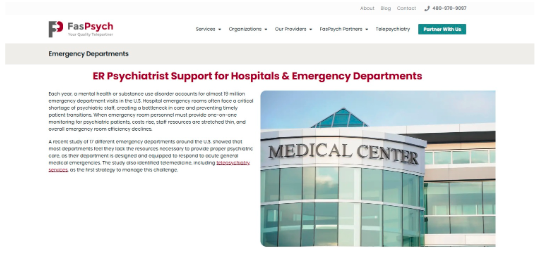
At a 2024 federal rural-health advisory meeting, an investor described FasPsych as providing night and weekend coverage to rural hospitals and mental health centers.. This is therefore worth noting as documented in a federal meeting record, but not independently verified as a clinical outcome.
Prisons
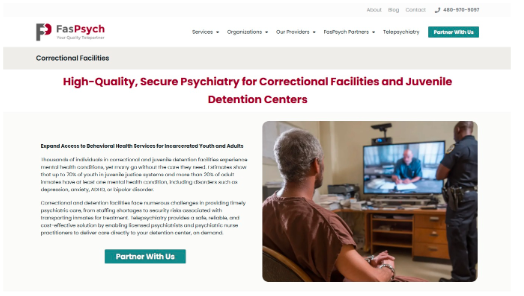
A similar range of cover would be available for both adults and juveniles detained. Coverage would need to be adapted to various other aspects of nursing and other care of detained patients and other security considerations.
It could avoid some journeys by patients outside their unit or prison, depending on all relevant considerations.
Costs
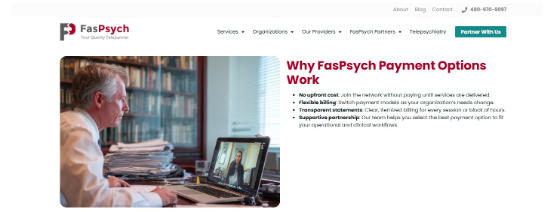
No indication of rates, but a number of billing options based on the timing and duration of input from practitioners available to negotiate, as appropriate to regular or more unpredictable requirements.
No cost appears to be incurred by joining the list of organizations able to avail themselves of this cover, with charges based on the agreed hourly, block, per diem, consultation or on-call arrangement. Costs would depend on various circumstances and requirements.
Other companies simply provide a program to allow video-link consultations, useful where suitable practitioners are already employed. As discussed, a major benefit here would be availability of practitioners as well as associated support.
What Public Feedback Shows
FasPsych publishes selected positive testimonials quoted by FasPsych. Further comments, both positive and negative on a variety of issues, including access to appropriate staff to supply institutions, can be found in a Google-derived review collection on Birdeye.
Pros and Cons
What works
- Primarily aimed at providing psychiatrists, apparently readily available throughout the country.
- Coverage across hospitals, correctional facilities and community clinics.
- Managed credentialing and technical preparation support.
- Various alternatives to purchase cover appropriate to likely requirements.
What does not
- Not a wide range of functions, such as a comprehensive set of records, that may be sought by some organizations, although unlikely to be relevant if existing systems are preferred and retained.
- Not trying to provide all types of medical speciality staff, although including some others such as psychologists and counselors. Probably not too relevant if looking specifically for psychiatrists.
- Primarily aimed at video-link consultations. Some other and occasional direct input may be possible. So probably not an ideal solution if most staff required to attend in person, although a useful supplement.
Conclusion
Useful source of appropriate additional practitioners for a range of situations and areas within a hospital or other medical facility, with a reasonable history and apparent range of measures to facilitate this.
Especially applicable to an established setting wishing to increase available psychiatric input, relieving various local staff to concentrate on direct care of patients.
Worth exploring further if a suitable type of cover is required.
 There is a specific skill involved in explaining something clearly — one that is completely separate from actually knowing the subject. Kimberly S. has both. They has spent years working with business finance insights in a hands-on capacity, and an equal amount of time figuring out how to translate that experience into writing that people with different backgrounds can actually absorb and use.
Kimberly tends to approach complex subjects — Business Finance Insights, Investment Strategies and Trends, Expert Business Advice being good examples — by starting with what the reader already knows, then building outward from there rather than dropping them in the deep end. It sounds like a small thing. In practice it makes a significant difference in whether someone finishes the article or abandons it halfway through. They is also good at knowing when to stop — a surprisingly underrated skill. Some writers bury useful information under so many caveats and qualifications that the point disappears. Kimberly knows where the point is and gets there without too many detours.
The practical effect of all this is that people who read Kimberly's work tend to come away actually capable of doing something with it. Not just vaguely informed — actually capable. For a writer working in business finance insights, that is probably the best possible outcome, and it's the standard Kimberly holds they's own work to.